
Reserve Bank Governor Raghuram Rajan on Friday said banking sector will see major changes in the coming years.

India's economy is not like Western ones, and thus needs restrained fiscal policy even during a recession, says Ajay Shah.

2015 is going to witness new agreements on climate change.

Prime Minister Mahinda Rajapaksa became the only member of the family to retain a cabinet position in his younger brother Gotabaya Rajapaksa's new cabinet of 17 ministers appointed on Monday, as the island nation was facing the worst economic crisis.
A long crisis with a lack of sound short-term, long-term actions can result in sluggish growth in India, similar to that in Japan.

Food delivery platform Zomato's initial public offering was oversubscribed on the opening day on Wednesday with retail investors bidding for 2.7 times the number of shares reserved for them. The offer received bids for 75.60 crore equity shares against an IPO size of 71.92 crore, stock exchange data showed. Retail investors sought 2.69 times the portion reserved for them. Against 12.95 crore shares reserved for retail individual investors, 34.88 crore shares were bid by 1700 hours.

'There will be political opposition, and this monetisation will require continued political will.'

The Finance Commission has substantially increased the allocation of funds to panchayats, but a large part of it is apportioned by state governments.

The finance minister asked lenders to identify eligible borrowers and reach out to them and urged for quick implementation of a sustained resolution plan for the revival of every viable business.

The oil crisis could not have come at a worse time for the Modi government as its tax collection has fallen short of its 2020-2021 target by Rs 5.2 lakh crore.

Former CAG Rajiv Mehrishi says Centre has held back a report he submitted to the President, to end what he called "a nightmare of accounts that militates against good governance".

United States Vice President-elect Kamala Harris has named her Chief of Staff, Domestic Policy Advisor and National Security Advisor -- an all-women team -- which she said has the experience to hit the ground from day one.

'The coronavirus epidemic highlights the need to start thinking more actively about multilateral coordination, including, but not confined to, health emergencies and climate uncertainties,' says Rathin Roy.

The former bureaucrat said he will take measures which the economy requires in a timely manner and as the first step, will meet the heads of public sector banks.

'Concerns about India's future are hampering private investment.' 'If the private sector sees strategy, teams and execution on these issues, this will inspire confidence in India.' 'This should be our main strategy for 2017,' says Ajay Shah.

'We are all in a tizzy about NBFCs in the aftermath of the IL&FS default.' 'We tend to jump to the notion that an NBFC is like a bank. But banks make a promise that deposits are liquid and have an assured return.' 'NBFCs make no such promises,' points out Ajay Shah.

In a first, the Comptroller and Auditor General's (CAG) officers reached out to several ministries in the last week of April as part of a confidence-boosting measure. The meeting brought the CAG officials and those from the ministries across the table to discuss the pain points in their relations. CAG of India Girish Chandra Murmu took this novel step because of growing tensions between those audited and the auditor.
The scheme is the biggest fiscal component of the Rs 20-lakh crore Aatmanirbhar Bharat Abhiyan package announced by Finance Minister Nirmala Sitharaman last month.

''Even without major reforms, with a business as usual scenario, and with current inflation trends, we should be clocking around 11 to 12 per cent nominal growth.' 'That is not happening and is a source of worry,' Rathin Roy tells Arup Roychoudhury.

21st century may have witnessed expansion of higher educational institutions, but who can afford it? Sushree Panigrahi & Jeet Singh look at the numbers.

But it is disappointing to note that Sitharaman's third Union Budget continues to promote a few problematic ideas, observes A K Bhattacharya.

Some say the MPC will raise the rate, while others are of the view that there is already de facto interest rate tightening through rising bond yields, which might prompt the central bank to go for a pause.

Several speakers noted that Budget carried the weight of expectations.

'When we say we want to increase pension participation, do we want to increase participation through the savings route?' 'Or do we want people to save in specific pension products?' asks Renuka Sane.

Undergraduate courses indicatively cost S$23,000 to S$38,000, while postgraduate courses approximately cost S$15,000 to S$40,000.

President Gotabaya Rajapaksa on Monday fired Basil Rajapaksa from his post and invited the Opposition parties to join a unity Cabinet to tackle the raging public anger against the hardships caused by the economic crisis.

The Union government has no 'Buy India' policy, but has a 'Buy Air India' policy.

According to the NIPFP, there is the possibility that even if the banking system matures over time, some transactions could bypass the system so as not to pay the BTT.

Officials said Sebi first proposed to the FinMin to amend the relevant provisions in the Sebi Act to discontinue RBI's representation on its board, as it already has adequate presence of government nominees and in its over 25 years of existence the regulator has evolved as an "effective and one of the best in the world".
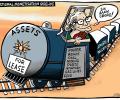
'This will have a multiplier effect in generating more jobs.'
The panel will also recommend a fiscal consolidation road map for the central and state governments, study the impact of GST on the divisible pool, and propose performance-based incentives for states.

RBI governor Raghuram Rajan and the government are working towards financial inclusion.

Their research paper on aid by rich nations got leaked

'What does the nation get out of the CBI's fabulous infrastructure? Very little that is useful.'
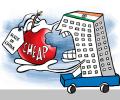
We import from China not because we love China, but because they sell us these things at cheap prices, points out Rathin Roy.

The culture of freebies burdens coming generations with the huge bill for the flagrant abuse of power by preceding governments, points out Virendra Kapoor.
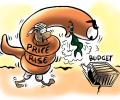
In absolute terms, fiscal deficit went up by 33.6 per cent in April-December 2017 and the revenue deficit by as much as 40.7 per cent compared to the same period the previous year, said Sudipto Mundle.
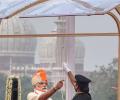
'India resembles not just the more turbulent bits of its own past, but other 'managed' democracies, where all institutional strength and independence have been hollowed out to serve political power,' notes Mihir S Sharma.

'We have to stop thinking about GDP and look at the impact on output and unemployment.' 'And that is not going to be insignificant.'
